In the spring of 2019, Rosa Whittaker laid out every knife in her Toronto kitchen on a wooden board on the dining table and counted twenty-two. This included a duck-shaped cheese spreader given to her at a wedding in 2007 and a serrated grapefruit knife she had used twice.
She gave eighteen away. She kept three.
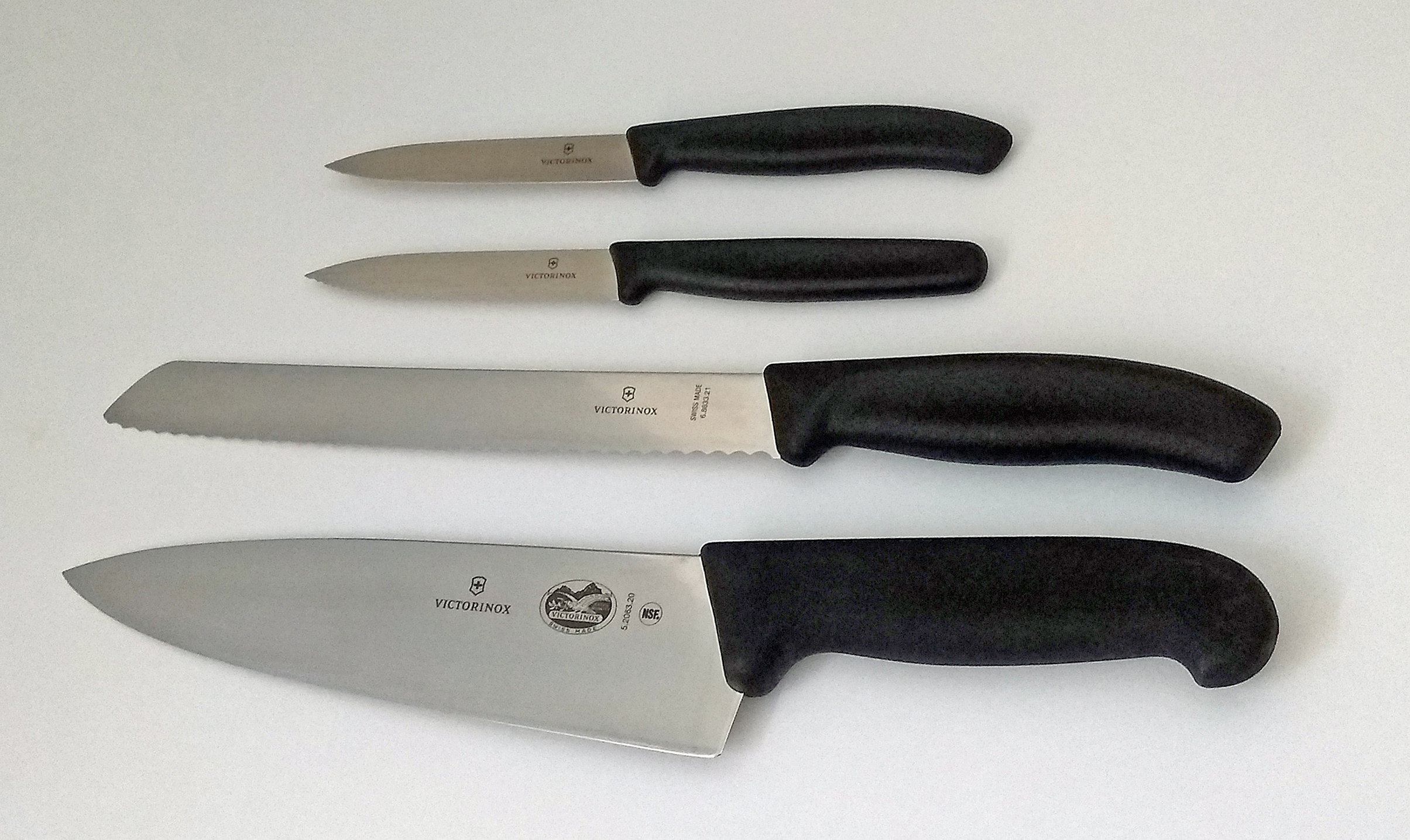
The three are these: a 210-millimetre Misono UX10 gyuto in stainless steel, bought new in 2014 from a shop on Yonge Street for around three hundred and sixty Canadian dollars; a Wüsthof Classic eight-inch bread knife inherited from her father in 1998; and a small Victorinox paring knife, the four-inch model with the plain plastic handle that costs about twelve dollars at any restaurant supply.
Seven years later, she has not bought another knife. She has not needed one.
The argument for a knife block stuffed with eight pieces and a sharpener is largely an argument made by the people who sell knife blocks. Most home cooks use the chef's knife for ninety percent of cuts, the paring knife for the small fiddly five percent, and the bread knife for the rest. The boning knife, the cleaver, the carving knife, the santoku, the utility, the fillet — these are real tools for real tasks, but the tasks are rare in a home kitchen, and the chef's knife will do all of them, less elegantly, when they come up.
Whittaker tested this in 2021 for a column. Over six weeks she logged every knife use in her kitchen. The gyuto did 1,043 of 1,196 logged cuts. The paring knife did 119. The bread knife did 34.
There is no fourth category that mattered.
On the question of which chef's knife: this is the hardest part to write honestly, because most chef's knives in the two-hundred-dollar-and-up range are very good, and the differences between them are real but small. The Misono UX10 holds an edge longer than a Wüsthof Classic of the same size. The Wüsthof is heavier and feels more substantial in the hand. A Tojiro DP at half the price cuts about ninety percent as well as either.
The honest answer is that the best chef's knife is the one whose handle fits your hand and whose weight matches what you are used to. Whittaker has small hands and prefers a Japanese-style D-shaped handle. A cook with larger hands often prefers the bolster-and-pinch of a German knife.
Go to a shop. Hold them. Buy the one that feels right. It will be the right knife for a decade if you take care of it.
Taking care of it means three things. Wash and dry it by hand immediately after use, not in the dishwasher. Store it on a magnetic strip or in a knife guard, not loose in a drawer where the edge will clatter against other metal. And keep it sharp.
The third one is the only one most home cooks skip. Whittaker estimates that two-thirds of the home kitchens she has visited contain a chef's knife that has not been sharpened since the day it was bought. The owner reports that the knife works fine. It does not. The owner has simply forgotten what a sharp knife feels like.
There are three sharpening options, in ascending order of work and cost. A pull-through ceramic sharpener at fifteen dollars will get a dull edge back to functional in thirty seconds and will, over years, slowly grind away too much steel. A whetstone in 1000 and 6000 grit, used every two months, will keep a knife in peak condition for its entire life and costs about ninety dollars for a decent set. A professional sharpening service, found in most major cities for about ten dollars per knife twice a year, requires no skill at all.
Whittaker uses a whetstone. She learned on a Naniwa Chosera 800 in 2010 from a Korean chef in Markham who watched her hands for twenty minutes and then told her to keep her wrist straight. The wrist is the entire technique. The rest is repetition.
Twenty minutes every six weeks. She does it on Sunday mornings, on a folded tea towel on the kitchen counter, with the radio on.
On the question of steel: there are sermons available online about high-carbon versus stainless, about Japanese versus German metallurgy, about HRC ratings of 61 versus 63. Most of it is interesting and almost none of it matters in a home kitchen. A modern stainless gyuto at 60 HRC will hold an edge through a week of normal cooking. A carbon steel knife will hold an edge longer and will rust if you leave it wet, which Whittaker is constitutionally unable to remember not to do. Hence stainless.
If you cannot afford a Misono or a Wüsthof, buy a Victorinox Fibrox eight-inch chef's knife for fifty dollars. It is the knife used in many professional kitchens for the line cooks who cannot bring their own. It is not as nice as a knife three times the price. It is much better than the knife you have now.
The paring knife matters less than people think. Whittaker uses hers maybe four times a week — to core a strawberry, to peel a hard-boiled egg in the shell, to slit a chicken thigh along the bone. The twelve-dollar Victorinox is genuinely as good as a ninety-dollar Wüsthof paring knife. She has owned both.
The bread knife matters more than people think. A dull bread knife is the most dangerous tool in a home kitchen, because it requires force, and force on a serrated edge through a crusty loaf produces, occasionally, a long shallow cut across the holding hand. A sharp bread knife glides. Whittaker has her father's Wüsthof sharpened once every three years by a service in Etobicoke that grinds the individual serrations on a special wheel.
She has not needed a fourth knife. She has not, in seven years, thought of a cut she could not make with the three she has.
There is a quiet pleasure in not owning the duck-shaped cheese spreader. The drawer is less crowded. The decisions, in the moment of cooking, are simpler. The right tool is always already in her hand.
Three knives. That is the answer.
Filed under