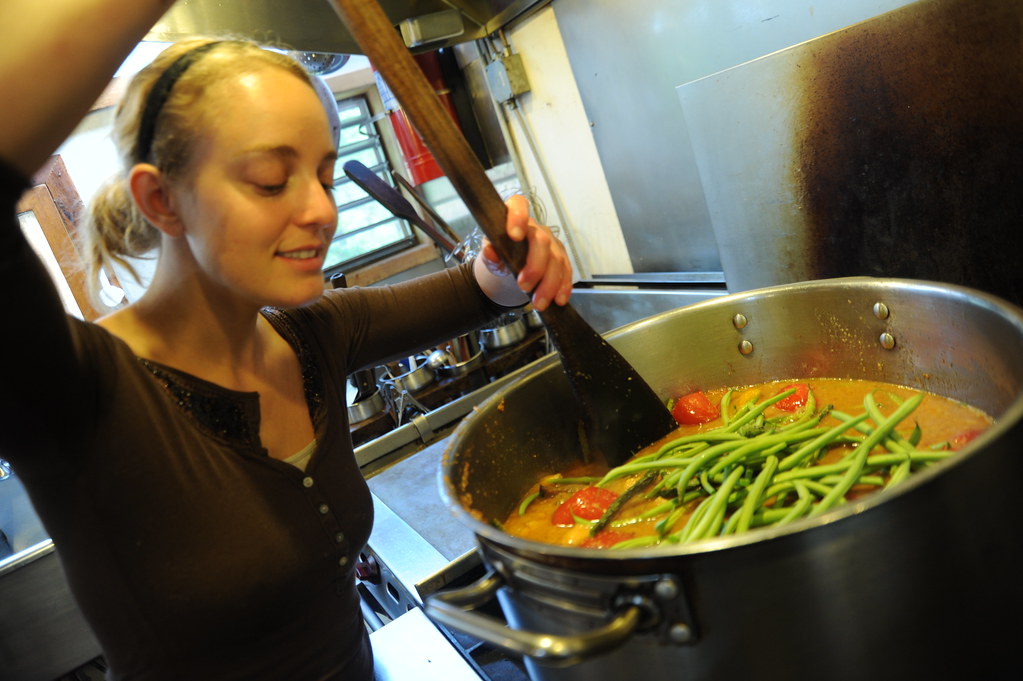
Lou Bertillon bought a wooden spoon at a hardware store in Brattleboro, Vermont, in August of 1999, the summer she was a line cook at a restaurant outside of Putney, for two dollars and ten cents including tax. It is made of beech. It is twelve inches long. The bowl has a slight oval shape, and the handle ends in a faint flare that fits the heel of her hand.
It has been the most-used tool in every kitchen she has worked in since.
There are eight other wooden spoons in the drawer next to her current stove in Brooklyn. Several are nicer. One is a French olive-wood spoon she was given as a gift in 2014. One is a Japanese cherry-wood saibashi. The Vermont spoon is the one she reaches for. The wood has darkened to the colour of strong tea. The bowl has worn into a slight asymmetry from years of being held in her right hand and dragged across the bottoms of pans.
This is not nostalgia. It is the spoon that does the job.
A wooden spoon does several things that metal and silicone do not. It does not conduct heat, which means the handle stays cool when the bowl has been resting in a 200-degree pan for ten minutes. It does not scratch the seasoned surface of cast iron or the enameled surface of Le Creuset. It does not melt at the edges if it is forgotten in a hot pan, which Bertillon has done more times than she will admit.
It also has, against a stainless steel pot, the right amount of friction. A metal spoon slides. A silicone spoon flexes. A wooden spoon catches the fond on the bottom of the pan in the way that a wooden spoon has always caught fond on the bottom of a pan, which is the way generations of cooks were taught to deglaze.
This is a small thing and it is the whole thing.
The wood matters less than people think. Beech, cherry, maple, olive, ash, walnut — they are all hardwoods, they are all dense enough not to splinter under heat, they are all food-safe. The differences between them are aesthetic. A walnut spoon is darker. An olive spoon has a beautiful grain. A beech spoon, which is the cheapest, performs identically.
The shape matters more. A round bowl is best for stirring liquids and for scraping the sides of a pot. A flat-edged bowl, sometimes sold as a roux spoon or a risotto spoon, is better for scraping the bottom of a pan, because the flat edge maintains contact with the flat surface. Bertillon owns both. She uses the round one for soups, sauces, and braises, and the flat one for risottos and for the bottoms of fond-heavy pans.
Length matters too. A short spoon, six or eight inches, is for mixing batters in bowls. A long spoon, twelve to fifteen inches, is for stirring pots on a stove without burning the back of the hand on the steam. Bertillon's Brattleboro spoon is twelve inches, which is the right length for most home stoves. For a deep stockpot, she keeps a fifteen-inch ash spoon from a kitchen supply in Long Island City.
On the question of care: wooden spoons require very little. Wash by hand, immediately after use, with warm water and a little soap. Dry standing in a jar so the handle is up and the bowl can drain. Do not soak. Do not put them in the dishwasher; the dishwasher is what kills wooden spoons, by saturating them and then drying them at high heat until they crack.
Once every six months or so, Bertillon rubs her spoons with a small amount of mineral oil — the food-safe kind sold in the drugstore for about four dollars a bottle — and leaves them overnight on a paper towel. The wood drinks the oil. The next morning, the spoons look slightly darker and feel slightly smoother, and they will not crack for another six months.
This is the entire maintenance.
A wooden spoon will last, with this treatment, somewhere between ten and forty years. The variance is mostly about how often it is used. A spoon that lives in the drawer and comes out at Thanksgiving will last forever. A spoon that is in a pan five nights a week will eventually wear thin at the edge of the bowl, and the handle will loosen its grain, and at some point — twenty years or so, in Bertillon's experience — it will simply not feel like the same spoon anymore, and it is time to retire it.
She has not yet retired the Brattleboro spoon.
There is a small school of online opinion that holds that wooden spoons are unsanitary because they are porous and harbour bacteria. The opposite is true. A 1993 study at the University of Wisconsin found that wooden cutting boards killed surface bacteria more effectively than plastic ones, because the wood's natural tannins are mildly antimicrobial and because moisture is pulled down into the wood and away from any surface organisms. The same is true of spoons.
Washed and dried, a wooden spoon is at least as clean as a metal one. Used wet and stored damp, both are equally unpleasant.
There is also a small school that holds that wooden spoons should be replaced regularly because they absorb flavours. This is partly true. A spoon used continuously for garlic and onions will, over years, take on a very faint background savouriness. A spoon used continuously for sweet things will not. Bertillon keeps one wooden spoon for sweet applications only — pudding, custard, jam, bread dough — and the others go into everything savoury without sorting. She has never noticed a transfer of flavour from one dish to another. She has noticed that her sweet spoon smells, faintly, of butter and vanilla, which she does not mind.
The most beautiful wooden spoons available right now, in her opinion, are made by a small workshop in southern Maine called Hawley Spoons, run by a woodworker named Annette Hawley, who carves each spoon by hand from a single piece of locally felled cherry. They cost between forty and ninety dollars. They are wonderful. They do nothing that the two-dollar Brattleboro beech spoon does not also do.
If you are going to spend forty dollars on a spoon, the right argument is that you are also supporting a small woodworker. That is a fine reason. The spoon will not cook better food.
What cooks better food is using the spoon every day. A wooden spoon is the only kitchen tool, in Bertillon's view, that improves with use. The bowl wears to the user's hand. The handle takes on a slight patina. The wood, after enough years, becomes the spoon you would not lend.
Hers is in the rinse rack now, drying, waiting for the next pot.
Filed under