Sam Park's Bonavita 1.0-litre variable-temperature gooseneck kettle, model BV382510V, sits on a small folding table by the window of his apartment in Mapo-gu, Seoul, where it has lived since he carried it home from an electronics shop in Yongsan in November 2018. It cost him 138,000 won.
Park has boiled water in it approximately 11,680 times. The number is conservative; it is four boils a day, every day, for eight years, with allowances for travel and a brief move.
The kettle still works. The thermostat clicks off at the set temperature within plus or minus one degree, as measured this morning with a Thermoworks Thermapen against a setpoint of 94. The hinge on the lid still snaps closed. The base still indicates the same six lights it indicated in 2018.
This piece is about why, and about what to look for in a kettle that will do the same.
The first thing to know about electric kettles is that almost none of them are built to last eight years. The category is a commodity. The cheapest models, around fifteen dollars, contain a single coil heating element, a bimetal thermostat, and a plastic body that yellows from the steam within two years. They boil water. They do not boil water repeatedly without failure.
The second thing to know is that the failure point is almost never the heating element. The heating elements in modern kettles, even the cheap ones, are rated for thousands of cycles. The failures are in the switch, the thermostat, the gasket, and the cord strain relief. These are small components that cost the manufacturer a few cents each and that fail under repeated thermal stress.
The Bonavita BV382510V was discontinued in 2021. Park bought his at the end of the production run. The replacement model, the BV382520V, uses a slightly different temperature controller and is, by most accounts, marginally less reliable. He has not tested this himself.
What made the 382510V durable is not a single thing. It is the absence of weak points. The body is 304 stainless steel. The base is a heavy plastic with a metal heating plate. The temperature dial is mechanical, not capacitive touch. The lid is a single piece. There are no rubber gaskets in the steam path that degrade with heat. The cord is a standard IEC C8 figure-eight, easily replaceable for about three dollars if it ever frays.
Park has not replaced the cord. He has not replaced anything.
He has, however, descaled the kettle every six months since 2019. Seoul tap water is not particularly hard, but it has enough calcium that visible scale builds up on the heating plate after about ten weeks. Left unattended, scale becomes an insulating layer that forces the heating element to work harder and run hotter, which is the single most common cause of premature kettle death.
The descaling method is simple. Half a cup of white vinegar, the rest of the kettle filled with cold water, brought to 100 degrees Celsius and left to sit for an hour. Then rinsed twice. The scale dissolves. The kettle is as good as it was.
Citric acid powder works as well as vinegar and does not leave a faint smell. Park used citric acid for the first three years, then switched to vinegar because he could buy it at any convenience store at midnight.
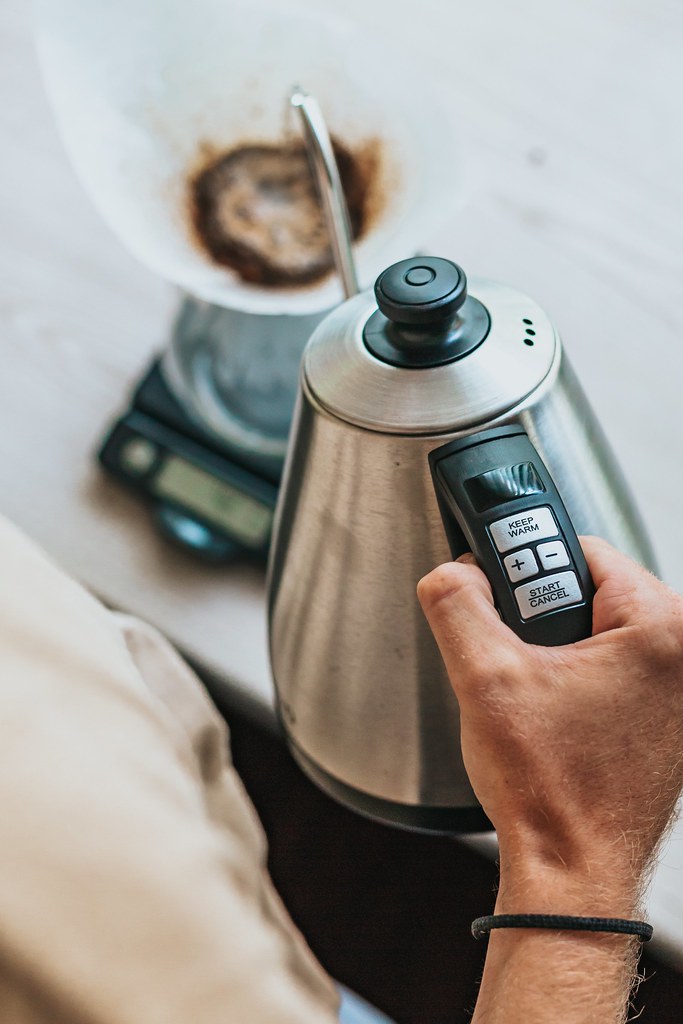
On the question of variable temperature: it is, for tea and coffee, genuinely useful, and most home cooks who own one and then have to use a plain on-off kettle find the experience irritating. 94 degrees for a pour-over coffee, 80 degrees for sencha, 100 for a French press, 75 for delicate green teas — these temperatures matter to the cup. A pre-set is faster than fussing with a thermometer and a guess.
The downside is that variable-temperature kettles have one more thing to break. The temperature sensor and the controller add cost and complexity. The Fellow Stagg EKG, currently the most popular gooseneck on the market, has a touchscreen controller that has been the subject of consistent failure reports in its third year. Park has held off on recommending it for that reason.
What would he buy today, if his Bonavita died tomorrow? Probably the Hario V60 Buono in stainless, a stovetop gooseneck used with a separate thermometer. It has no electronics to fail and will last thirty years. The compromise is that you have to watch it and pour the water off the boil through a thermometer-aware mental adjustment, which is a small skill and is acquired in about a week.
If he wanted electric, he would probably try a Brewista Artisan, which uses a similar mechanical controller to the old Bonavita and has been on the market long enough that early failures would be visible.
The question Park hears most often from readers is whether to buy a gooseneck at all, if the only use is boiling water for instant coffee or oatmeal. The honest answer is no. A wide-mouth electric kettle from a reputable brand — Cuisinart, Breville, the Korean brand Kuvings — will do the job for half the price and last about as long.
The gooseneck is for the slow pour. It is for laying a thin stream of water onto coffee grounds in a deliberate spiral. It is, in some sense, a tool whose purpose is to slow down the user. If that is not what you are buying, you do not need it.
What Park is buying, four times a day, is the small ritual of two minutes by the window watching the temperature climb. The kettle is the metronome. It clicks. He pours.
His grandfather kept the same enamel stovetop kettle on the same stove in the same kitchen in Jeonju for forty-one years. The lid was dented from the time it had fallen off the stove in 1981. The whistle had been replaced once, in 1994. Otherwise the kettle was as it was when Park's grandmother bought it in 1958, just before they were married.
Park does not expect his Bonavita to last forty-one years. He hopes for fifteen. He thinks, on the evidence of the last eight, that fifteen is achievable.
If it is not, he will buy a Hario, and the slow pour will continue with a different vessel and the same purpose, and the morning will still proceed at the speed of water coming to a boil.
Filed under