There are four mustards in the door of Lou Bertillon's refrigerator in Brooklyn, and each one earns its place by doing something the others cannot.
On the top shelf, a small jar of Maille Dijon Originale, the supermarket Dijon that costs about five dollars and tastes like a sharper version of what most American mustards aspire to. This is the workhorse. It goes into vinaigrettes, into pan sauces, onto sandwiches when nothing more interesting is at hand.
Below it, a slightly larger jar of Edmond Fallot Burgundy mustard from a small importer in the Hudson Valley. This is the better Dijon, used when the dish will showcase the mustard rather than hide it. On a thick slice of country ham. In a vinaigrette for warm asparagus. Spooned onto a boiled potato with butter.
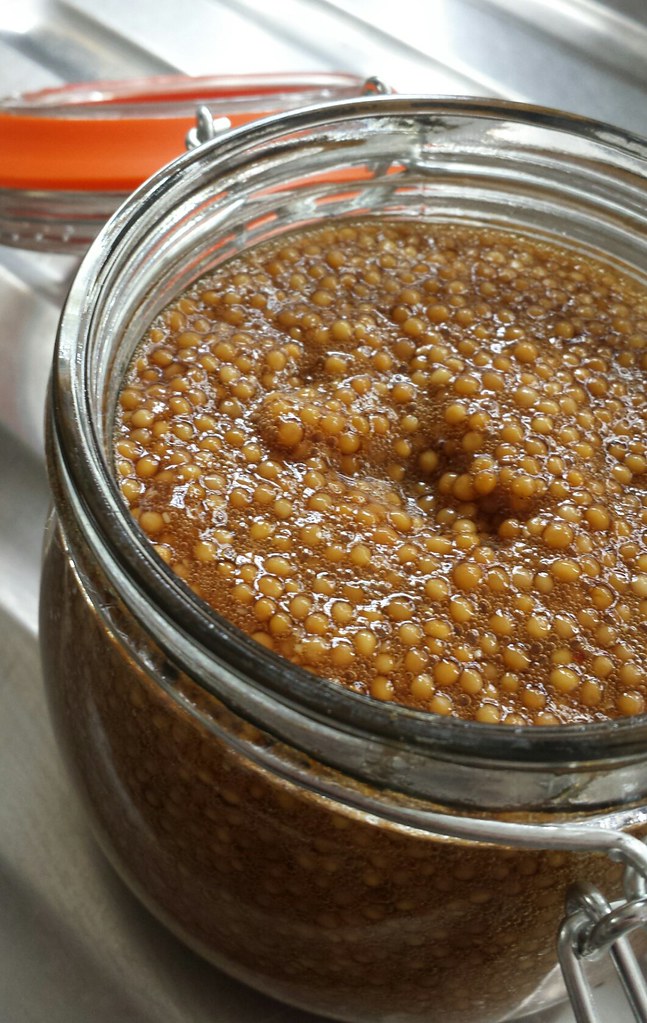
On the second shelf, a tall jar of Pommery old-style grain mustard, the one that looks like brown caviar and crunches faintly when you bite it. This is the mustard for charcuterie, for cold roast pork, for the bistro-style remoulade that Lou makes with celery root in the winter.
And at the bottom, a small jar of Colman's English mustard powder that Lou mixes fresh as needed. The powder keeps almost indefinitely. The made-up mustard, mixed with water and given five minutes to develop, is hotter than anything in a jar. It goes on roast beef sandwiches, into a quick mustard glaze for ham, and into a vinaigrette where the assertive heat is the point.
Four mustards. They have all been in the refrigerator since at least February. None of them is older than a year. The rotation is unhurried but deliberate.
Lou's habit of keeping multiple mustards comes from twelve years of restaurant cooking, where there was always a tub of grain mustard for the cheese plate, a squeeze bottle of Dijon for the line, a small ramekin of English for the ham service, and a jar of honey mustard for the kids' menu. She brought the habit home and pared it down.
The case for keeping multiple mustards in a small home kitchen is the same as the case for keeping multiple vinegars. The base ingredient is similar but the applications are different. Dijon and grain mustard behave differently in a vinaigrette. A grain mustard adds visual interest and a softer heat. A smooth Dijon emulsifies more reliably. An English mustard will overwhelm almost any vinaigrette and is better used elsewhere.
The economics are forgiving. A jar of mustard, even a good one, is a few dollars. A jar will last several months in a cool refrigerator. The investment per use is trivial.
The risk is rancidity, which with mustard is less about oxidation and more about loss of heat. Mustard is at its sharpest when freshly mixed or freshly opened, and the volatile compounds that produce the heat fade over time. A jar of Dijon opened eighteen months ago is a milder, gentler thing than a jar opened last week. It is still mustard. It is no longer the same mustard.
This is why the English mustard powder is in the rotation. The powder retains its potency for years. The freshly mixed paste is hot in a way no jarred mustard can match, because the heat is being released at the moment of use rather than slowly leaking out of a jar over months.
Lou mixes the Colman's about once every two weeks. A teaspoon of powder, a teaspoon of cold water, stirred with a small wooden spoon in a tiny ramekin. Five minutes of rest. The five minutes are non-negotiable. Mustard powder mixed with water needs the time for the myrosinase enzyme to act on the glucosinolates and produce the heat. Mix it too fresh and it is bland. Wait too long and the heat starts to fade.
She learned this from a chef named Theodora Maddox at a restaurant in the West Village in 2014. Theodora kept a tiny container of Colman's powder on her station and would mix small amounts as needed throughout service. The mustard for the ten o'clock cover was always fresher than the mustard for the seven o'clock cover, and the difference was real.
Some applications and the mustard they call for.
Vinaigrette. A teaspoon of Maille Dijon, whisked with vinegar before the oil. The Dijon is an emulsifier as well as a flavoring. Grain mustard works but produces a less stable emulsion.
Pan sauce after a roast chicken. A teaspoon of Fallot Burgundy, swirled in with butter at the end. The better Dijon stands up to the chicken fat in a way the supermarket Dijon does not.
A cheese plate with a slab of country pate. The Pommery grain mustard, in a small dish on the side, with a tiny spoon.
A roast beef sandwich on rye. Fresh-mixed Colman's, thinly spread. A thin spread is essential. A thick spread will close the sinuses.
A salad of warm boiled potatoes and shallots and parsley. The Fallot Burgundy, whisked into a vinaigrette with red wine vinegar and olive oil and a pinch of salt. The mustard rounds the dressing and helps it cling to the potatoes.
A glaze for a baked ham. A tablespoon of fresh-mixed Colman's, a tablespoon of honey, a teaspoon of grain mustard, smeared on the ham before the last twenty minutes of baking. The combination of heat and crunch and sweetness is the point.
Deviled eggs. The Pommery grain mustard, mashed into the yolks with mayonnaise and a touch of vinegar. The visual texture of the grains is part of the appeal.
There are mustards Lou does not keep. A honey mustard, which she makes when she needs it. A Beaujolais mustard, which she tried for a year and found indistinguishable from her Burgundy mustard. A tube of Japanese karashi, which is a different ingredient entirely and lives elsewhere. A jar of yellow ballpark mustard, which has its uses but not in her kitchen.
The four-jar rotation is not a rule but a working principle. It is the smallest set of mustards that covers what Lou actually cooks, with one specialty (the Colman's powder) for the applications where freshness is the point. Anyone running a different kitchen will land on a different four. The exercise is to land on four, rather than nine.
The refrigerator door is a small ecology. The mustards live next to the cornichons and the capers and the small jar of preserved lemons, and they get used a few times a week. None of them is old. None of them is rancid. None of them is decorative.
Which is, in the end, the only test that matters.