Petra Sloane keeps three jars of mustard in the door of her refrigerator at all times. They sit in a row on the second shelf from the top, in front of a bottle of capers and a tube of anchovy paste she has owned, by her own admission, for too long.
The leftmost jar is a sharp yellow English mustard, the kind that opens the sinuses. The middle jar is a coarse-grained brown mustard with white wine and tarragon. The rightmost is a sweet honey-mustard that her partner Alasdair eats on cheese.
She makes all three at her kitchen counter in a flat above a butcher's shop in Marchmont, Edinburgh. The whole operation, for a year's supply, takes her about ninety minutes spread across three afternoons.
She does not buy commercial mustard and has not since 2011.
The seeds come from a spice merchant on West Nicolson Street called Khanna and Sons, which has been there since 1978. She buys yellow mustard seeds and brown mustard seeds in 500-gram bags. Brown seeds are sharper. Yellow seeds are milder. Most commercial English mustards use both.
She also keeps a small jar of black mustard seeds for an Indian-style tempering oil that is not, strictly, a condiment, and is not the subject here.
The English mustard is the simplest. She measures one hundred grams of yellow seeds and fifty grams of brown into a glass bowl. She grinds them to a coarse powder in a small electric coffee grinder she keeps only for spices. The grind takes about forty seconds.
She stirs the powder with cold water — never hot, which kills the volatile heat — to a thick paste, and lets it sit for ten minutes. The mustard activates as it hydrates. After ten minutes it is at its hottest. She adds a teaspoon of fine sea salt, a tablespoon of white wine vinegar, and stirs.
The vinegar fixes the heat at its current level. Without it, the mustard would mellow within an hour. With it, the jar will keep its bite in the refrigerator for six months.
She scrapes it into a small Weck jar and labels the lid with a date in pencil. English. 04 April.
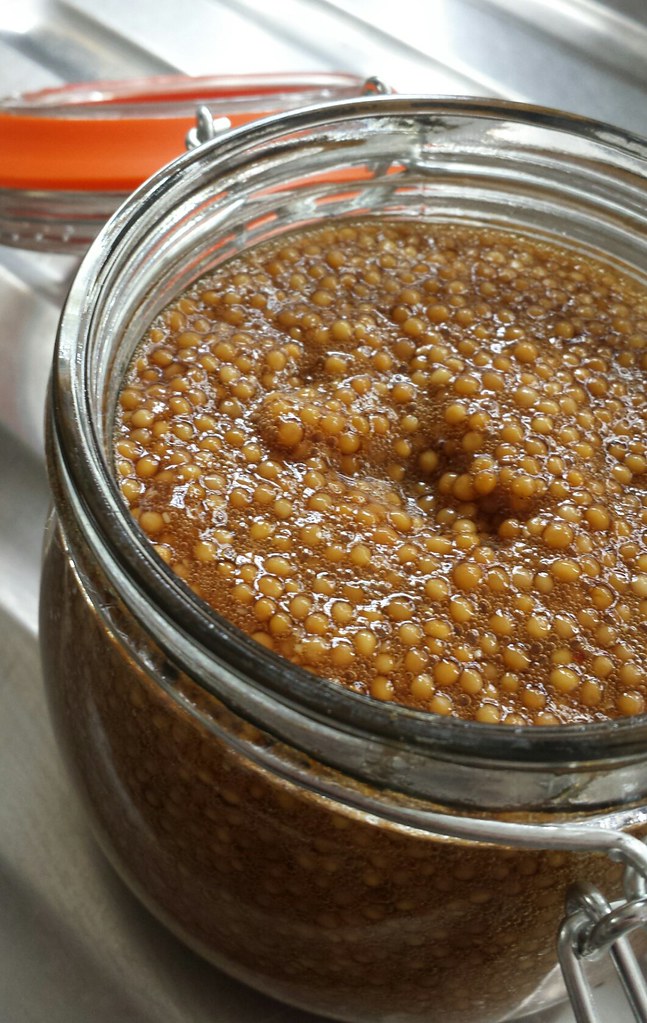
The brown grainy mustard requires more time and slightly more patience. She soaks one hundred grams of brown seeds in seventy-five millilitres of dry white wine and seventy-five millilitres of cider vinegar overnight, in a covered bowl on the counter. By morning the seeds have swelled and softened.
She pours the soaked seeds into the bowl of a small food processor with a teaspoon of salt, a tablespoon of honey, and a small handful of fresh tarragon leaves. She pulses six or seven times, just enough to crack about a third of the seeds and leave the rest whole.
The texture should be like wet caviar.
This one she lets sit, sealed, for forty-eight hours at room temperature before refrigerating. The flavour rounds out considerably. Fresh from the processor it is harsh and one-noted. After two days on the counter it has become something more interesting — wine-forward, herbaceous, with the slow burn of mustard underneath.
It goes on roast pork, into vinaigrettes, alongside a wedge of sharp cheddar.
The honey mustard is, she admits, the one she makes mostly to please Alasdair, who grew up eating a commercial honey mustard that no longer exists. He has been chasing the memory of it for two decades. Her version is not quite right, but it is close enough that he stopped asking about the original around 2018.
For this one she grinds fifty grams of yellow seeds finer than for the English — almost to a flour — and whisks the powder with three tablespoons of cider vinegar, two tablespoons of cold water, and four tablespoons of a wildflower honey from a beekeeper in Peebles. She salts it, lets it stand for twenty minutes, and stirs in a half-teaspoon of ground turmeric for colour.
It is sweet, but not cloying. The mustard heat asserts itself at the back of the tongue after the honey has done its work at the front.
All three jars live in the fridge door for between four and six months. She remakes whichever runs out first, usually the brown grainy. The English she eats slowly, on ham, on cold beef, beside Yorkshire puddings on a Sunday.
She is asked at least once a quarter whether it is worth making mustard at home given how cheaply it is sold in supermarkets. Her answer is honest. The English costs her about the same as a Colman's tin once you account for the seeds. The grainy is cheaper than any decent supermarket equivalent. The honey mustard is roughly break-even.
The reason she does it is not economic. The reason is that fresh mustard, made on a Wednesday afternoon and eaten on a Friday, tastes like a different ingredient than the one in the jar in the shop. Anyone who has done the comparison knows.