Sam Park's mother, Park Hye-jin, lived in Cleveland from 1981 to 2003, and during those twenty-two years she developed a Saturday-night brisket that the family ate roughly twice a month from October to April.
The brisket started on Friday morning, when she trimmed a six-pound flat to a quarter inch of fat cap and rubbed it with a mixture she never wrote down.
From what Sam can reconstruct, the rub was salt, brown sugar, garlic powder, smoked paprika, black pepper, and a small amount of ground coffee, in proportions he is still negotiating with his own kitchen.
She brined the rubbed brisket, wrapped in plastic, in the refrigerator from Friday morning until Saturday afternoon. Roughly thirty hours.
On Saturday at four, she seared it in a Dutch oven on the stovetop in beef tallow she rendered herself, browning all four sides until the fat cap was the colour of polished walnut.
She added a halved onion, a head of garlic split crosswise, a bottle of dark beer, two cups of beef stock, three bay leaves, and a chunk of Korean radish she had picked up at the Asian grocery on Payne Avenue.
The Dutch oven went into a 275-degree oven at five, covered, and did not come out until ten that night. Five hours.
By ten, the brisket would have been completely tender if you tested it with a fork, but Park Hye-jin did not serve it then. She turned the oven off, left the brisket in the covered pot in the cooling oven overnight, and went to bed.
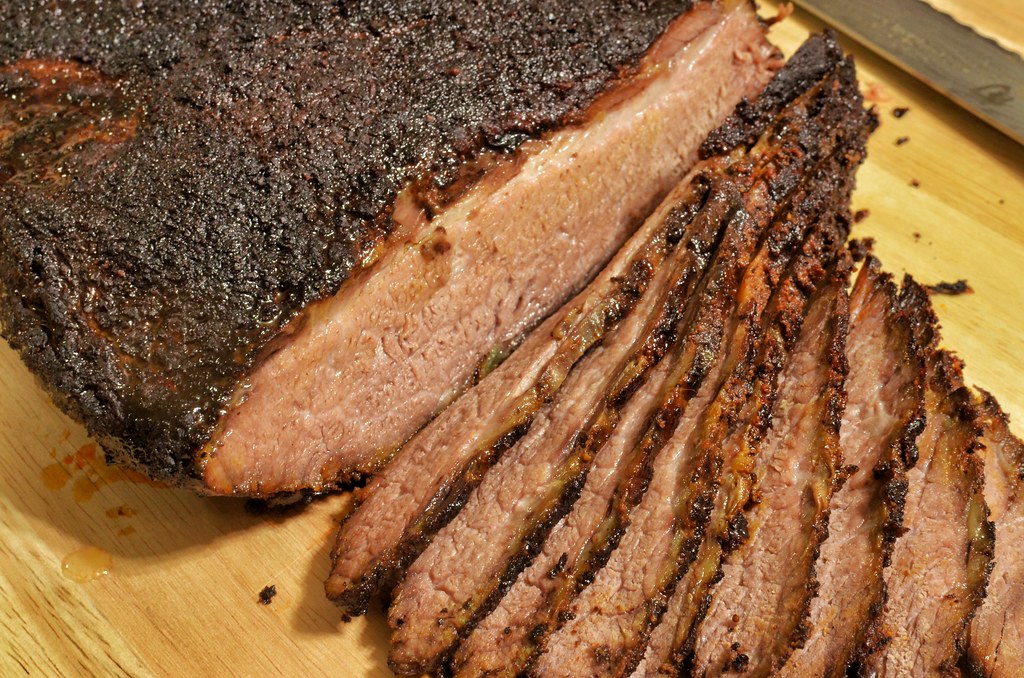
Sunday morning she lifted the brisket out, sliced it cold against the grain on a wooden board, returned the slices to the strained, defatted braising liquid, and reheated the whole thing gently in a 300-degree oven for forty minutes before the family ate at one in the afternoon.
Sam, who is now thirty-eight and lives in a small apartment in central Seoul, has been trying to reproduce this brisket since 2011.
The difficulties are these. He does not have his mother's Dutch oven, which was a wedding gift from her brother Park Jin-ho in 1980 and stayed in Ohio when his parents moved back to Daegu in 2003.
He does not have her oven, which was a Frigidaire that ran twenty degrees hot, a fact she compensated for by setting it to 255 when she wanted 275.
He does not have her rub, which she made by feel and which she did not write down before she died, in Daegu, in 2019.
What he does have is the basic timeline. Brine Friday. Sear Saturday. Long cook Saturday afternoon. Cool overnight in the pot. Slice cold. Reheat in the braising liquid. Eat Sunday afternoon.
He has found, after fifteen years, that the overnight cool is the load-bearing step. A brisket sliced hot, on Saturday night, is good. A brisket sliced cold and reheated in its own liquid, on Sunday afternoon, is something else.
The slicing is easier cold. The slices reheat without drying. The liquid penetrates the meat in a way it cannot when the meat is hot and contracted.
He cooks the brisket about once a month in winter, less in summer. The yield feeds him and his partner, Han Yujin, for two meals, with leftovers for sandwiches on bread he buys from a small bakery near Anguk Station.
He has settled on a rub of three tablespoons of salt, two of brown sugar, one of garlic powder, one of smoked paprika, two teaspoons of black pepper, and one teaspoon of finely ground espresso, per pound. He keeps revising the espresso.
He uses a six-quart enameled cast-iron pot from a Korean manufacturer, bought in 2017, that holds heat almost as well as the Cleveland Dutch oven did.
The result is, by his estimation, about eighty percent of his mother's brisket. The missing twenty percent is, he suspects, a function of the Ohio water, the Frigidaire, the brother-in-law's wedding gift, and the fact that he is not his mother.
He has stopped trying to close that gap. The eighty percent is enough. The smell of the kitchen on Saturday evening, and the slow Sunday reheat, and the cold board on Sunday morning with the long knife, are most of what he was after.