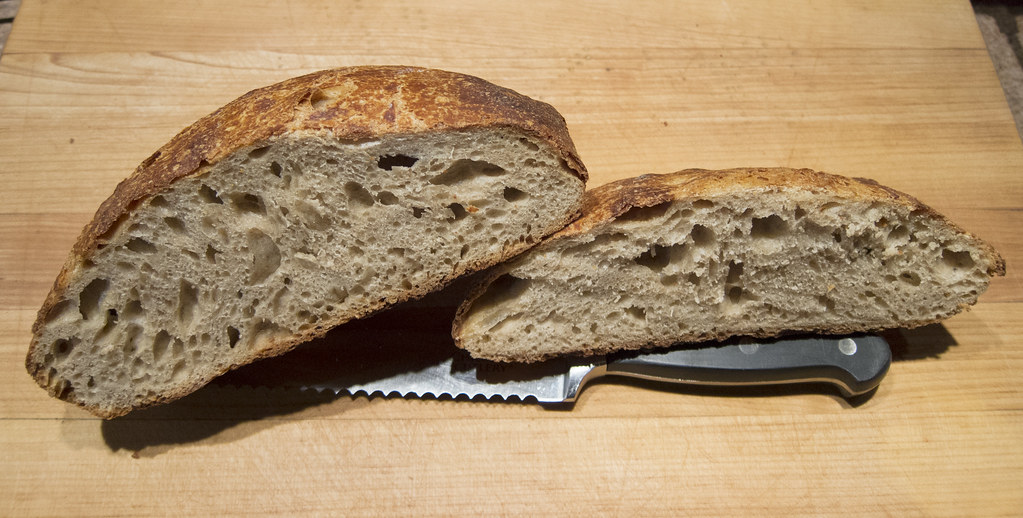
Adrian Coate baked his first no-knead loaf on a Sunday afternoon in October 2014, in a rented kitchen in Northeast Portland, in a borrowed enamelled cast iron pot that he later bought from his landlord for thirty-five dollars.
He has baked some version of it, on and off, for almost twelve years.
The recipe came from Jim Lahey by way of Mark Bittman's 2006 column in the New York Times, the column that, more than any other piece of food writing of its decade, taught a generation of American home cooks that they could make a serious loaf of bread without owning a stand mixer or knowing what a poolish was.
Three cups of bread flour, a quarter teaspoon of instant yeast, a teaspoon and a quarter of fine salt, one and five-eighths cups of water. Stir together with a wooden spoon. Cover. Wait twelve to eighteen hours. Shape. Wait two more. Bake in a screaming-hot covered pot.
The whole thing takes a day and a half, of which the active time is maybe fifteen minutes.
What Adrian liked about it at twenty-six was the magic. What he likes about it at thirty-eight is the math. The yeast is so reduced that the dough takes care of itself overnight on the counter, fermenting slowly while he sleeps. The hydration is high enough that the dough is too wet to knead and does not need to be. The pot, preheated to 475 degrees Fahrenheit, makes its own steam from the dough's own moisture.
There is nothing about the recipe that requires you to be present in the kitchen at any particular moment. This is, he has come to think, its great gift.
He has made variations. He has done a fifty-fifty white-and-whole-wheat version that he prefers for sandwiches. He has done a version with a tablespoon of dark rye, which he likes for toast. He has done a version with chopped olives folded in at the shaping stage, which is good but not memorable.
He has never moved on to sourdough, despite many polite suggestions from his sister-in-law in Eugene, who keeps a starter in a corked Bordeaux bottle and is patient with him about it.
The reason, he has decided, is not laziness. It is that the no-knead loaf gives him what he wants from a loaf — a crackling crust, an open but not enormous crumb, the smell of bread in his apartment on a Sunday morning — without asking him to be the kind of person who keeps a living thing on his counter.
He travels a lot, for one. Two weeks in February he was in Texas reporting on dried beans. Three weeks in March he was in Vermont working on a piece about maple. A starter would not have forgiven him. A packet of instant yeast in the freezer will.
The pot, the original enamelled Dutch oven from 2014, finally cracked on its lid in 2022. The base is still in service. He bought a second pot, a bare cast iron combo cooker, and now uses whichever one is clean.
He has thoughts about flour. He used King Arthur bread flour for the first seven years. He switched in 2021 to Camas Country Mill flour, milled in Junction City an hour south of Portland. The loaf got slightly better, slightly more characterful. He is not sure how much of that is the flour and how much is that he is now twelve years more practiced at making this bread.
He keeps the salt in a small bowl on the counter, not in a shaker, the way the line cook he briefly dated in 2017 taught him.
He has thoughts about timing. The eighteen-hour ferment is forgiving. He has gone to twenty-two hours when life intervened. He has gone to thirteen when a friend dropped by for dinner. The dough, in his experience, is hard to ruin if you keep the yeast quantity low.
He bakes the bread on Sunday mornings, mostly. The dough is mixed Saturday after lunch. He turns the oven on at ten on Sunday with the pot inside. He bakes the loaf by eleven. He eats the first slice, with butter, before noon.
The bread goes stale by Wednesday. He eats it as toast through Thursday. The heel becomes croutons for a Friday salad. Sometimes there is enough left to make French toast on a Saturday morning, full circle.
The thing he would tell a person starting out, if asked, is that the first loaf is going to be the best loaf they have ever made. The second loaf might be a little worse. The tenth loaf will be quietly better than the first. The hundredth loaf will be the loaf they actually wanted all along, and they will not remember when it became that.
He has now baked, he estimates, more than four hundred of these loaves. He has stopped counting. The recipe is on a piece of paper in a drawer. He has not looked at the paper in years.
Filed under