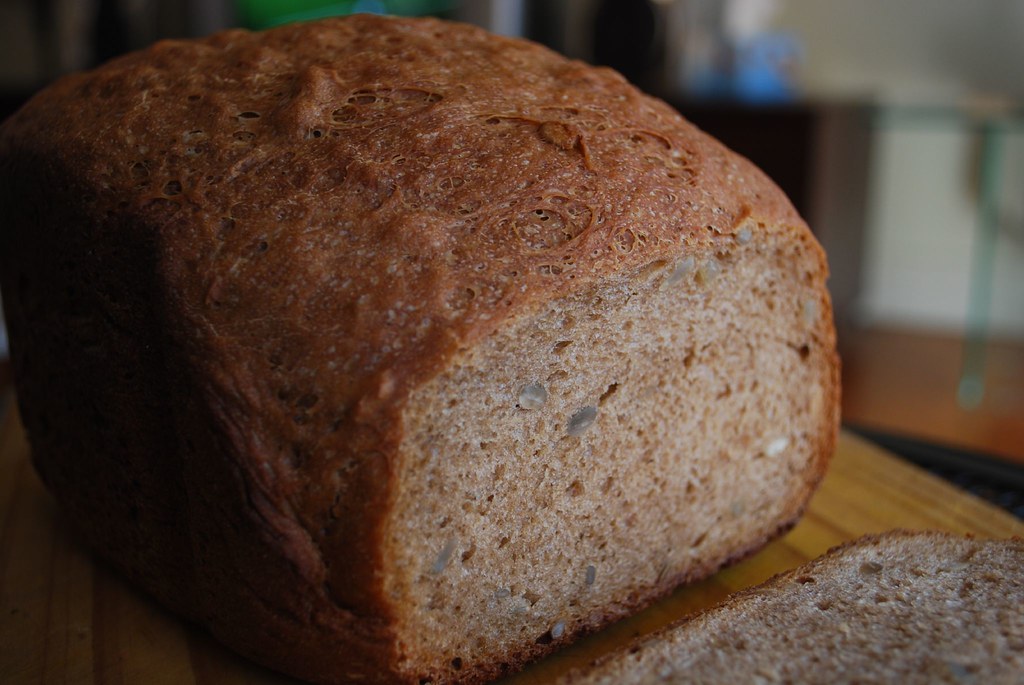
On the last Sunday in April, in a kitchen on NE Killingsworth Street in Portland, Adrian Coate mixed a dark rye loaf at quarter past nine in the evening.
He was watching a basketball game with the sound off and a beer half-finished on the counter beside the mixing bowl. The Trail Blazers were losing, calmly and as expected, to the Sacramento Kings.
The dough took about eight minutes to mix. He covered the bowl with a plate, put it in the cool corner of the kitchen near the back door, and went to bed at half past ten.
The loaf is for Monday lunch, and for every lunch until it is gone. This is the rye Adrian has been baking, on and off, for about five years.
He came to it because he was tired of buying sliced rye at the supermarket. The supermarket rye, even from the good bakery on Mississippi, is sliced too thin for the sandwiches he likes, and it goes stale by Wednesday in a way that suggests improvements he was not consulted about.
His loaf is squat, dense, faintly sour, dark enough to look serious, and forgiving on the third or fourth day in a way that white bread is not.
The recipe came together by trial. It owes something to a Stanley Ginsberg formula in The Rye Baker, something to a small Lithuanian bakery in Northeast Portland called Vilnius Loaf that closed during the pandemic, and something to Adrian's own pantheon of preferences, which run toward caraway and toward a not-too-tight crumb.
Two cups of medium rye flour from Bob's Red Mill, which is milled in Milwaukie just south of Portland and which is the best rye flour Adrian can get without ordering it. One and a half cups of bread flour. A heaping tablespoon of toasted caraway seeds, crushed in a mortar and pestle. A tablespoon of dark molasses. A tablespoon of cocoa powder, unsweetened. A teaspoon and a half of fine salt. A scant half-teaspoon of instant yeast. A cup and three-quarters of warm water.
Mixed with a wooden spoon until it forms a stiff, slightly sticky dough. Covered. Left on the counter overnight.
By seven in the morning, the dough has risen by about half. It is not airy in the way a wheat dough is airy. Rye dough never quite gets there. What it does is settle and acquire flavour.
Adrian shapes it on a floured counter into a tight log, sets it seam-side down in a buttered loaf tin lined with parchment, covers it loosely with a clean tea towel, and goes to take a shower.
Forty-five minutes later, when he comes back, the dough has filled the tin. He scores the top with two diagonal slashes. He brushes the top with a little water and scatters a few extra caraway seeds.
Into a 425-degree oven for fifteen minutes, then down to 375 for another thirty-five to forty. The loaf comes out almost black on top, the kitchen smelling like a Vilnius street in November, the loaf making faint pinging sounds as it cools on the rack.
He leaves it to cool until lunchtime. Rye, he has learned the hard way, needs to be fully cool to cut cleanly. If you slice into a warm rye loaf, you get gum.
By twelve-thirty he has cut two slices, each about a centimetre thick, and built the sandwich that is the whole reason this exercise exists.
Two slices of Black Forest ham from the German butcher on NE Alberta. A thick smear of Maille Dijon mustard. A few thin slices of dill pickle. A handful of arugula. A second slice of the rye on top.
He eats it standing at the counter, the way he eats most lunches, while reading the morning's email.
The same loaf carries him through Tuesday and Wednesday. Tuesday is the ham again. Wednesday is a tin of sardines mashed with a little lemon juice and parsley, on toasted rye. By Thursday the loaf is firm enough that he toasts it for everything.
There is sometimes a heel left on Friday. The heel gets diced into croutons for a kale Caesar that Adrian makes most Friday nights, which is not the point of the loaf but is a happy consequence.
He bakes the loaf again on the following Sunday, around the time the basketball game starts. The kitchen smells faintly of caraway from the week before. He notices it for a moment and then he does not notice it any more. This is, he thinks, what it means to have a household bread.