The crock arrived in 1998, in a flat box wrapped in brown paper, from a small pottery in Harrowsmith, Ontario. It was a gift from Rosa Whittaker's aunt, who had bought one for herself the year before and decided, after watching her niece eat three helpings of sauerkraut at Thanksgiving, that the next generation deserved one too.
It is a five-litre Harsch-style fermentation crock, stoneware, with a moat-and-lid water seal and two ceramic weights that sit on top of the cabbage. It has not left Rosa's kitchen counter for more than a week at a time since.
She fills it once a year, in October, when the cabbage at her local farmers' market on Bloor Street is at its best. The vendor is a woman named Halina who farms a small plot near Bobcaygeon and brings in green cabbages the size of small footballs from the second week of September through the first hard frost.
Rosa buys three heads in the third week of October. The total weight is usually about four kilos.
The recipe she follows is the one printed in the booklet that came with the crock, which she has lost and rewritten from memory twice. It is essentially: cabbage, salt, weight, time.
She halves and quarters each head with a long chef's knife — one of the three knives she owns, a 240-millimetre Misono that she bought in 2003 and has resharpened on a whetstone every three months since. She cuts out the core and slices the quarters thin against the grain, working over a large enamel bowl.
The slicing takes about forty minutes for the three heads.
She weighs the shredded cabbage on a kitchen scale she keeps under the sink. For every kilo of cabbage she measures twenty grams of fine sea salt — a two-percent ratio that is the standard for sauerkraut and the one she has never had reason to vary.
She mixes the salt through the cabbage with her hands in the enamel bowl. She covers it with a tea towel and leaves it for thirty minutes.
In thirty minutes the salt has drawn enough water from the cabbage that the shredded leaves are sitting in a small pool of brine. The cabbage has wilted and softened. This is the moment she begins to pack.
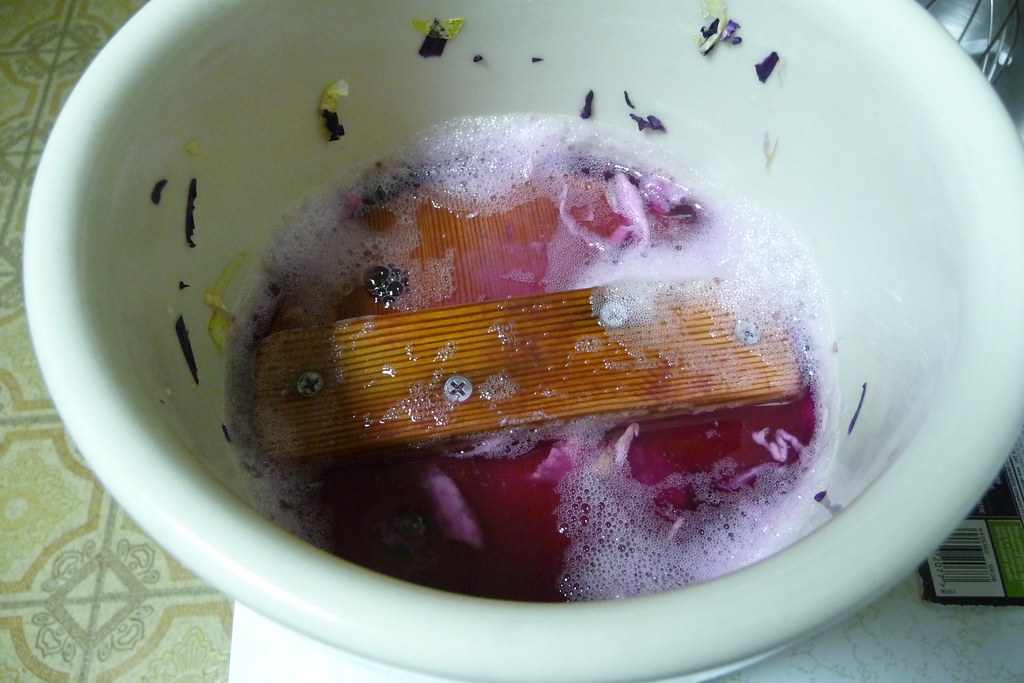
She loads the cabbage into the crock in small handfuls, pressing each handful down with her fist before adding the next. The brine rises as she packs. By the time the crock is two-thirds full, the cabbage is fully submerged in its own liquid.
She presses one more time, hard, with the flat of her hand. She lays the two ceramic weights on top. The weights sit just below the surface of the brine. She fills the moat with cold water, lowers the lid into the water seal, and steps back.
The crock goes on the kitchen windowsill above the radiator, where the temperature stays around eighteen degrees Celsius through the autumn.
For the first three days the crock burps. Carbon dioxide from the lactic-acid fermentation bubbles out through the water seal with a faint clucking sound. By day four the activity has slowed. By day seven it has nearly stopped.
She does not open the crock for four weeks.
In the fourth week she lifts the lid for the first time. The smell is sharp and clean — a good fermented smell, not a putrid one — and the cabbage has gone from green to a pale gold. She tastes a forkful. It is sauerkraut. Tart, crunchy, alive.
She transfers about a third of the kraut into two litre Mason jars, which go into the refrigerator. The rest stays in the crock at room temperature for another two weeks, where it will develop further complexity, and then it too is jarred and refrigerated.
From November through March the jars rotate through the meals of the household. She eats sauerkraut with sausages on a Sunday. She folds it into a Reuben sandwich on a Saturday afternoon. She tops a winter borscht with a tablespoon of it. She eats it cold, out of the jar, standing at the open refrigerator at midnight more often than she would care to admit.
By April the last jar is empty. The crock goes through the dishwasher's top rack and back into the cupboard until October.
She has been asked whether it is worth the trouble, given that decent sauerkraut is available at any decent grocery in Toronto for four dollars a jar. Her answer is that her sauerkraut tastes like the cabbage Halina brought from Bobcaygeon, not like cabbage from a factory in Pennsylvania. The difference is not abstract. The difference is on the fork.
The crock will outlive her. She has told her niece, who is twelve, that it goes to her when the time comes. The niece, so far, is not interested. But Rosa has time.