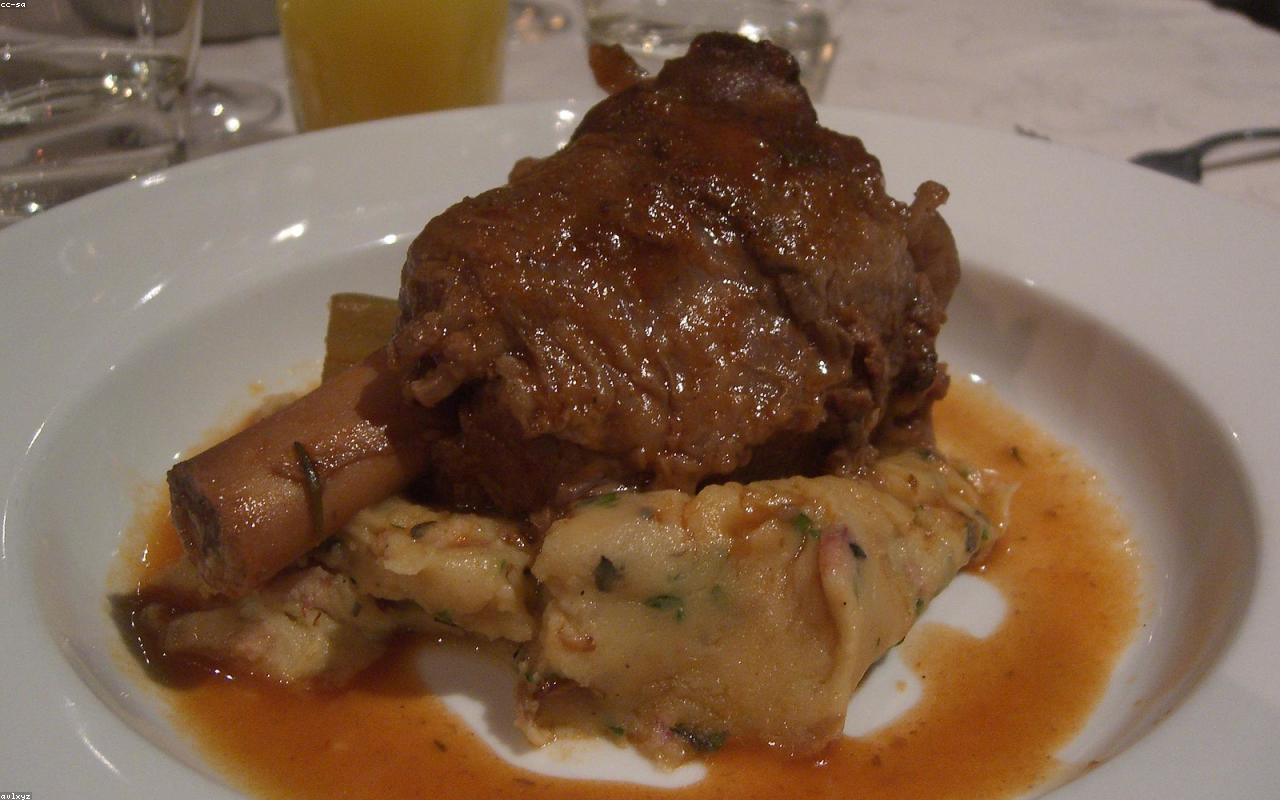
On a cold Tuesday in early June, which in Portland that year still required a wool sweater after sundown, Adrian Coate seared four veal shanks in his cast-iron Dutch oven on a burner turned almost as high as it could go.
He had bought the shanks on Monday from a butcher on Northeast Alberta Street, a man named Wallace Inkster who has cut for Coate for nine years and who tied the shanks with butcher's twine before wrapping them.
Coate seared each shank for about four minutes a side, in two batches, in a thin film of olive oil. The browning was the entire flavour foundation of the dish, and he did not rush it.
He lifted the shanks onto a plate, lowered the heat under the pot to medium, and added a chopped onion, a chopped carrot, two ribs of celery, and four cloves of garlic, smashed.
He cooked the soffritto for about twelve minutes, until the onion was nearly translucent and the carrot had begun to soften, scraping up the brown fond from the bottom of the pot with a wooden spoon as he went.
He added a tablespoon of tomato paste and let it cook for a full two minutes, until it had darkened from red to almost brick.
He deglazed with a cup of dry white wine, a Vermentino from a small importer in Eugene, and let it reduce by half, scraping the bottom of the pot.
He returned the shanks to the pot, added two cups of homemade beef stock from his freezer, two bay leaves, a strip of lemon peel, and enough water to come halfway up the sides of the shanks.
He covered the pot with parchment cut to size and the lid, and slid it into a 300-degree oven at one in the afternoon.
At three he turned the shanks. At four-thirty he turned them again. At six he pulled the pot.
The shanks were exactly tender, which is to say a fork went in with very little resistance but the meat had not yet started to fall apart from the bone.
He lifted them onto a warm platter and tented them with foil. He reduced the braising liquid in the pot on the stovetop for about ten minutes, until it had body but had not turned syrupy.
He made gremolata while the sauce reduced: the zest of one lemon, two tablespoons of finely chopped parsley, two cloves of garlic minced very fine, and a pinch of salt.
Coate is firm on the gremolata. Without it, he says, the osso buco is a heavy dish that sits on the tongue. With it, the lemon and the raw garlic cut through and lift the whole thing.
He served the shanks on a bed of saffron risotto, which he had started forty minutes before the shanks came out and finished while the sauce reduced.
The risotto used the bean broth from his Saturday pot, which is a heresy in Milan and a sensible substitution in Portland.
He ate two of the shanks at his small kitchen table, alone, with the radio on low. The other two he refrigerated for Wednesday and Thursday.
The marrow he scooped out of the bones with the small marrow spoon his sister Briar gave him for his fortieth birthday in 2017. It went onto a slice of toasted sourdough with a pinch of salt.
The dish on a Tuesday night, eaten alone, is not melancholy. Coate has been doing this long enough that it has settled into a small ritual.
Tuesday is a working night. He teaches a class on Tuesday evenings until six. The osso buco is in the oven while he teaches, the timer set on his phone for five o'clock, when his assistant Briony Falk pulls it out of the oven at his apartment and turns the heat to low.
He pays Briony in osso buco. She takes one shank home on Wednesday and reports back. Last week the report was that the gremolata needed more lemon. This week he doubled the zest.
By eight on Tuesday night the apartment smells of veal and lemon and white wine, the dishes are mostly washed, and the second shank is in a covered container in the refrigerator for tomorrow's lunch.
Coate has cooked osso buco perhaps four hundred times. It is not a dish he ever feels he has fully mastered. The bones change, the marrow changes, the wine changes. He keeps cooking it on Tuesdays in winter and into early summer, and he keeps making small adjustments to the gremolata.