On a wet Saturday in early February, Adrian Coate carries a paper bag of Eureka lemons up two flights of stairs to his apartment on SE Clinton Street in Portland. There are twenty-six lemons in the bag. He has paid forty-two dollars for them at the small Vietnamese grocery near 26th, where the owner, Mr. Linh, sets aside thin-skinned fruit for him in the second week of every month from January through April.
He has been doing this for nine years.
The jar he uses is a four-litre Le Parfait with a glass lid and an orange rubber gasket. He bought it at a restaurant supply on Sandy Boulevard in 2017 for nineteen dollars. He has never owned another preserving jar that size, and he has never needed one.
The salt is Diamond Crystal kosher, the red box, which he buys in three-pound increments and stores in a wide-mouthed ceramic crock on the counter. He does not weigh his salt for this recipe. He has measured it a dozen times and always arrives at the same proportion: roughly a cup and a half for a gallon jar packed tight with fruit.
The method, he will tell you, has been described better elsewhere — by Paula Wolfert, by Claudia Roden, by a thousand tagine recipes — but his attachment to it is procedural rather than scholarly. He does it because the kitchen smells like lemons for two hours, and because in April, when the jar is ready, he can reach in for a quarter of a peel and put it on almost anything.
He begins by scrubbing each lemon under cold water with a vegetable brush, because the rind is the entire point. Eurekas waxed for shipping are useless. The Mr. Linh lemons are not waxed.
He trims the stem end flat. Then he stands each lemon upright on the cutting board and makes two cuts: one straight down through the centre, stopping three-quarters of the way, and a second cut perpendicular to the first, also stopping short. The fruit opens into four wedges still attached at the base. He calls it the petalled cut, though he has no idea where he picked up the term.
He works over a sheet pan to catch the juice.
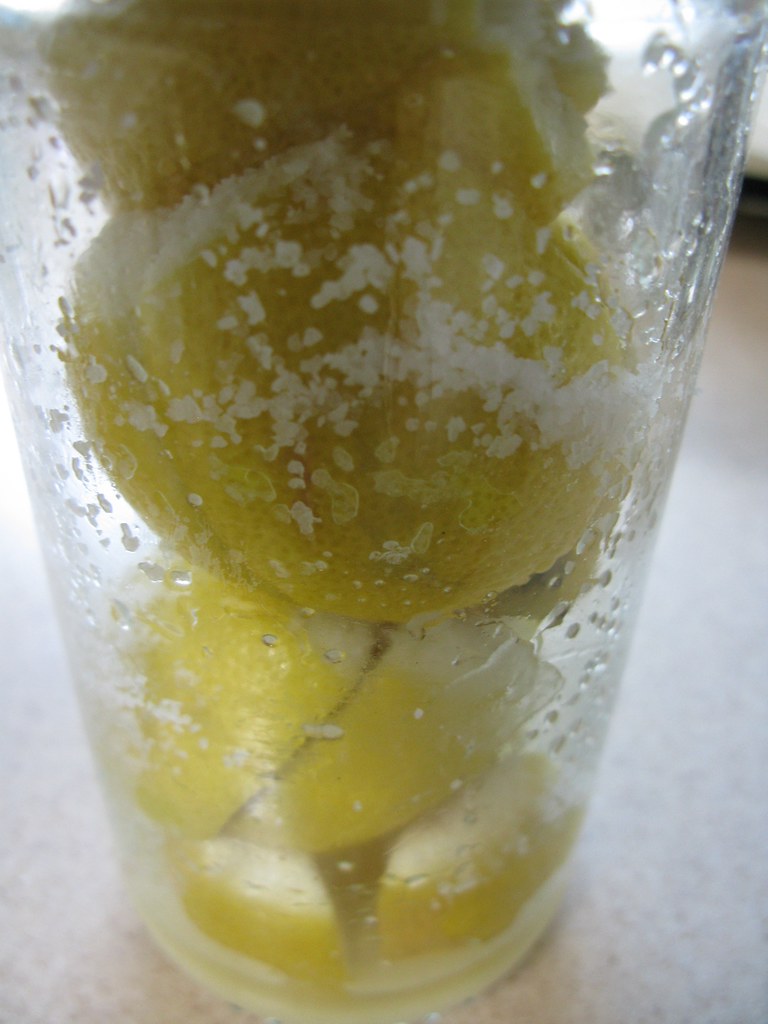
Into the cavity of each opened lemon he packs about a tablespoon of salt, more than feels reasonable. He closes the fruit around the salt with both hands. The salt immediately begins to weep the juice out.
He puts a half-inch layer of salt in the bottom of the jar, then begins to load the lemons. He presses each one down with the flat of his fist before adding the next. The juice rises. By the time the jar is two-thirds full, the lemons at the bottom are submerged.
He always runs out of room before he runs out of lemons. The last three or four fruit get juiced over a bowl, and that juice goes into the jar to top it up. If there is not enough, he opens a second lemon and squeezes it in. The fruit at the top must be covered in liquid, or the exposed peel will mould.
He weights the top with a small ceramic disc — a tart-tin liner he repurposed years ago — and seals the jar. He puts it on the kitchen counter beside the radio, where he will see it.
For the first week he turns the jar upside down once a day and back. By the end of the week the salt has dissolved entirely and the jar is full of pale yellow brine. The lemons have softened. He moves the jar to a shelf above the stove and forgets it for six weeks.
In late March he opens it. The smell is intense and slightly sulphurous for the first ten seconds and then settles into something floral and saline. The peel has gone translucent and slightly soft. The flesh has collapsed.
He pulls out a quarter and scrapes the pulp away with a butter knife, because he uses only the peel. The pulp goes back into the brine. The peel he rinses briefly, slices thin, and folds into a bowl of cooked Castelluccio lentils with olive oil and parsley. He eats it standing at the counter.
That is the first meal of the lemon year.
From there the jar travels through everything. He minces the peel into a chicken-thigh braise with green olives and saffron. He stirs it into yogurt for a marinade. He puts a tablespoon on a roast carrot at the last minute. In June he chops it with fresh dill and folds it into cold farro for lunch.
By August the jar is half empty and the brine has darkened to amber. The remaining peel is softer, more concentrated. He uses less of it now per dish.
By November the jar is nearly finished. He saves the last quarter-lemon for a beef shank stew on a cold Sunday. The brine, by then, has become its own ingredient — he adds a tablespoon to vinaigrettes through December and into the new year.
He starts a new jar in February. The empty jar gets washed in the sink with hot soapy water, rinsed three times, and left upside down on a dish towel overnight to dry. He has not sterilised a preserving jar in nine years and has never lost a batch.
The whole annual operation costs him under fifty dollars and produces about three hundred meals' worth of flavour. He thinks of it as the most reliable line item on his pantry ledger, and he recommends it to anyone who will listen — which, in his experience, is fewer people than the recommendation deserves.